



No matter what industry you’re in, a recent warning letter to a cosmetics company in India is a must-read, as it contains photos taken during an inspection.
The March 12 letter to Patcos Cosmetics Pvt. Ltd. of Daman, India references an unannounced inspection of its drug manufacturing facility last July, where investigators found what CDER characterized as "significant violations" of cGMP and "insanitary conditions" so severe that the agency invoked Section 501(a)(2)(A), the adulteration provision for insanitary conditions that may render products injurious to health.
The letter itself is a wrenching catalog of serious findings:
Broken windows adjacent to open processing lines
Evidence of harborage areas
Mold-like residue in product storage
An unvalidated water system riddled with design flaws
Unvalidated manufacturing processes
Missing identity testing on high-risk components
Deliberate alteration of laboratory data to conceal out-of-specification results
The facility was already on Import Alert 66-40 and had received a prior warning letter in December 2023, and responded to that letter by re-registering with the FDA, affirming its "ongoing compliance with current Good Manufacturing Practices" and "adherence to the highest quality standards." The agency was clearly unimpressed.
But here’s what caught our attention: the letter includes photographs.
Specifically, the FDA included photographic evidence of the insanitary conditions: images of harborage areas outside the production floor, a broken window next to open processing lines, and production-area sinks used for cleaning equipment that appear to be in a state of advanced neglect.
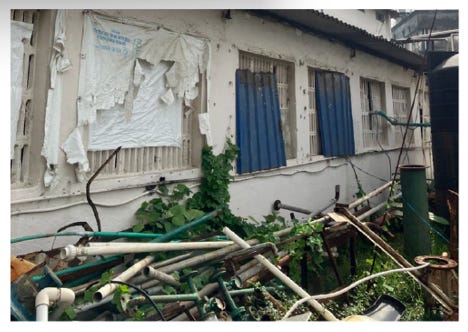
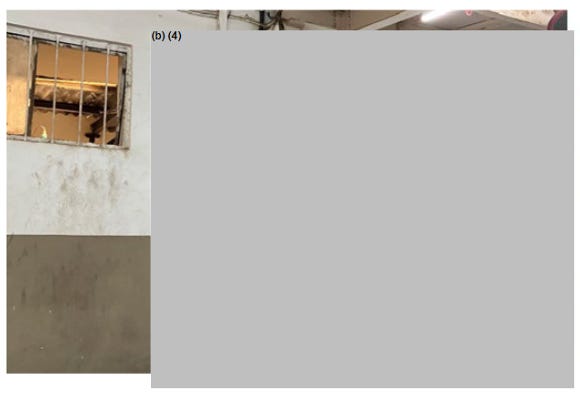
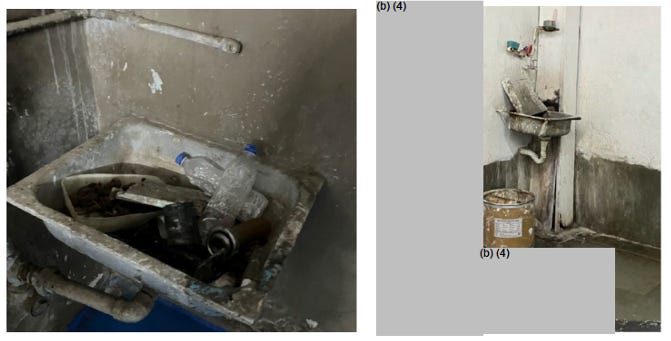
The agency added a footnote explaining that “CDER is including photographs of your facility in this warning letter to document the gross insanitary conditions violations.”
It’s one thing to read that sinks were “insanitary.” It’s quite another to see them.
Companies have periodically refused to allow photographs, citing trade secrets, IP concerns, or internal security policies. As recently as late 2024, the agency issued a warning letter to a Chinese drug manufacturer that cited “limiting photography” as a standalone violation after the company refused to allow inspectors to photograph dirty filling machines. The FDA’s position has been firm: if you’re manufacturing drugs for the U.S. market, allowing investigators to document what they observe is part of the deal, and refusal may be treated as obstruction.
In its June 2024 guidance on the circumstances constituting delaying, denying, or refusing a drug or device inspection, the FDA addresses limiting photos explicitly:
B. Limiting Photography
Photographs are an integral part of an FDA inspection because they present an objective and contemporaneous representation of facility conditions. Examples of conditions or practices effectively documented by photographs include but are not limited to: evidence of rodents or insect infestation; faulty construction or maintenance of equipment or facilities; product storage conditions; product labels and labeling; and visible contamination of components, containers, closures, or products. Impeding or resisting photography by an FDA investigator may be considered a limitation if such photographs are determined by the investigator to be necessary to effectively conduct that particular inspection.
Examples of potentially reasonable explanations that might result in the drugs or devices not being deemed adulterated under section 501(j) of the FD&C Act include, but are not limited to:
The chemical properties of products manufactured at the facility are such that taking photographs would adversely affect product quality.
The facility can document that taking photographs of any raw material or assembly would adversely affect product quality
Why this matters for the broader industry
If this becomes a pattern, and given this administration’s stated emphasis on “radical transparency” across FDA operations, it has implications well beyond a cosmetics manufacturer in India.
Warning letters are public documents. They’re read by competitors, customers, investors, law firms, and journalists. The text of a letter is already reputationally damaging. Photographs transform that damage from abstract to visceral. A written description of “water damage with brown discoloration of the ceiling and walls and green mold-like residue” is concerning. A photograph of it is devastating, and shareable in a way that regulatory prose is not.
For all manufacturers, this is worth watching. If the agency begins routinely including photographic evidence in warning letters, the reputational stakes of a facility walkthrough finding just went up significantly.
The calculation around facility maintenance, housekeeping, and environmental controls shifts when you consider that the conditions an inspector observes might not just appear as a paragraph in a letter (they might appear as an image that circulates on LinkedIn and in trade press).
We don’t yet know whether the Patcos letter is an isolated case driven by the severity of the conditions or the beginning of a broader practice. But the footnote suggests intention rather than improvisation. We’ll be watching subsequent letters to see if photographs become a recurring feature.
In the meantime, if you haven’t walked your own facility with fresh eyes recently, this might be a good time to do it!
Read the full warning letter here.
Need audit or mock inspection support? Let’s talk.
Contact us to access our exclusive pool of 3,750+ global consultants, 235+ of whom are former FDA. If we haven’t yet partnered on project support, we provide end-to-end audit support and intensive, comprehensive mock FDA inspections that not only mirror real inspections but go deeper, giving you the insights, corrections, and readiness you need before the FDA walks through your doors.
With a staff of thousands of resources worldwide, we’re the partner firms work with when they want deep domain expertise and the peace of mind that comes with a partner whose commitment to quality and integrity reflects their own.
Whether you need a complete audit program design, full execution, or specific audit support, we’re here to help. Learn more here.

Who is The FDA Group?
The FDA Group helps life science organizations rapidly access the industry's best consultants, contractors, and candidates. Our resources assist in every stage of the product lifecycle, from clinical development to commercialization, with a focus on Quality Assurance, Regulatory Affairs, and Clinical Operations.
With thousands of resources worldwide, hundreds of whom are former FDA, we meet your precise resourcing needs through a fast, convenient talent selection process supported by a Total Quality Guarantee. Learn more and schedule a call with us to see if we’re a fit to help you access specialized professionals and execute your projects on time and on budget.