



These RA/QA news rolls are available in full only to paid subscribers. Upgrade here. If you haven’t already taken our reader survey, it should only take 1 minute here.
This is our biweekly recap of news and industry happenings curated for our paid subscribers. Our goal is to bring you the headline news and the stories, research, and insights that might be harder to find.
If you haven’t upgraded to a paid subscription yet, you can do so here. Also, make sure to follow us on LinkedIn and catch the latest episodes of our podcast, The Life Science Rundown.
Here are some key items from the past couple of weeks.
💊 = Pharma, biologic, and biotech.
💉 = Medical device, medtech, diagnostics, and digital health.
Special Announcement!
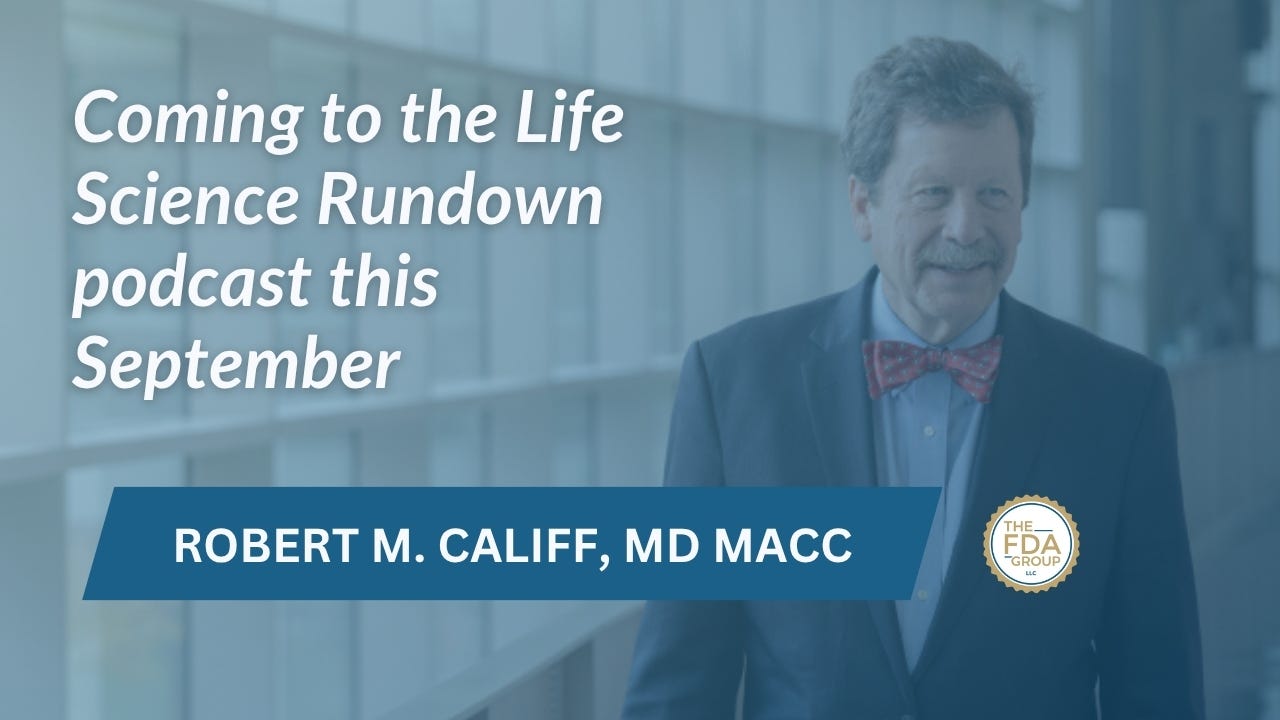
We're excited to announce a very special guest coming on the Life Science Rundown podcast in September: Robert M. Califf, MD, MACC!
Dr. Califf currently serves as an Instructor in the Department of Medicine and a Member of the Duke Clinical Research Institute at Duke University, and is an Adjunct Professor of Medicine in the Division of Cardiology. He previously served as FDA Commissioner and Deputy Commissioner for Medical Products and Tobacco. Before his FDA roles, Dr. Califf was a professor of medicine and vice chancellor for clinical and translational research at Duke, director of the Duke Translational Medicine Institute, and founding director of the Duke Clinical Research Institute.
He is also a Member of the National Academy of Medicine, has served on multiple FDA advisory panels and NIH advisory committees, and has led major initiatives to improve methods and infrastructure for clinical research, including the Clinical Trials Transformation Initiative (CTTI).
More details to come. If you aren't already, make sure you're subscribed wherever you listen to podcasts so you don't miss our conversation! We’ll of course post it here on the Insider Newsletter, too.
Alright, back to our regular newsroll items:
FDA Leadership and Administration
Commissioner search ends with a pick: The White House’s search for a permanent FDA commissioner turned several times this month, with reporting that Rep. Buddy Carter (R-Ga.) had entered the running before later reporting indicated President Trump had picked White House policy aide Heidi Overton for the job. Carter is a licensed pharmacist who previously ran his own pharmacy and is leaving Congress at the end of this term after losing his state’s Republican primary. Reporting through the summer had described a three-way contest between Overton, senior Pentagon health official Stephen Ferrara, and New York Cancer & Blood Specialists Chief Executive Jeff Vacirca. Overton’s confirmation runs through the Senate HELP Committee, where several members are expected to treat mifepristone regulation as a litmus test. Acting Commissioner Kyle Diamantas can continue serving until early December under the Vacancies Act, a term that extends upon the White House's formal submission of a nominee. We wrote about Heidi Overton here:
HHS plans two new deputy commissioner roles: CNBC reported that HHS is planning to appoint deputy commissioners for drugs and for technology at the FDA, two positions that would report directly to the commissioner and oversee medical product portfolios. The FDA previously had a deputy commissioner for medical products and tobacco, a role once held by former Commissioner Robert Califf before it was eliminated under former Commissioner Scott Gottlieb. According to the report, the technology and artificial intelligence position could go to FDA senior advisor Jared Seehafer, who joined the agency last year and previously led the quality management software company Enzyme. No candidate has surfaced for the drugs role. Taken together with the pending commissioner nomination, the vacant principal deputy commissioner position, and the unfilled permanent director jobs at CDER and CBER, the agency’s leadership structure is likely to look substantially different by the start of 2027, with center directors holding less influence than they do now.
Tarver meets with a sterilization firm and a standards body: 💉 The FDA’s leadership public calendar shows two entries for CDRH Director Michelle Tarver, one with representatives from Steris and the other with the British Standards Institution. The topic of the Steris meeting was not listed, though the firm plays a significant role in the device supply chain, an administrative priority. The BSI meeting is notable because the organization does not currently appear in the agency’s database of recognized consensus standards.

FDA General
FDA opens the conversation on regulating generative AI devices: 💉 The FDA issued a discussion paper on the regulation of generative artificial intelligence-enabled medical devices, open for comment through October 19. Digital Health Center of Excellence Director Rick Abramson described the paper as a jumping-off point rather than a formal policy statement. The proposals include a new type of master file for the foundation models that underpin AI functions and a competency-based approach to performance assessment, drawn from clinician credentialing. Some concepts fall outside current agency practice, including the involvement of users of generative AI tools in postmarket surveillance planning. Abramson told STAT in a subsequent interview that the agency wants input from the broader ecosystem before translating the concepts into policy, and that the eventual guidance will be stronger because it has gone through the process.
Citizen petition asks where vision language models fall: 💉 A citizen petition from Mosaic Clinical Technologies asks the FDA to clarify where AI-enabled vision language models sit within its regulatory paradigms. As the petition describes it, some VLM functions fall outside FDA oversight under the statutory definition of software as a medical device, while others would be regulated as devices. The petition specifically asks whether a VLM marketed with the expectation of later fine-tuning on institution-specific data is itself a device requiring premarket clearance or approval, whether such a model is a component or a finished device, and how these tools fit the agency’s carve-out for the practice of medicine.
New draft guidance on choosing between ANDA and 505(b)(2): 💊 The FDA issued draft guidance on August 17 that would revise and replace 2019 recommendations describing whether a sponsor should submit an Abbreviated New Drug Application or a 505(b)(2) application. The ANDA pathway covers generic drugs, while 505(b)(2) applies to products closely related to but not identical to already approved drugs. The new draft adds information on duplicates and ANDA approval eligibility, clarifies language throughout, and adds footnotes. Updating this guidance has sat on the agency’s agenda since at least 2023.
Therapeutic equivalence guidance finalized: 💊 The FDA released a final guidance describing how it determines whether a brand-name product and its would-be generic are therapeutically equivalent and how it assigns the resulting Orange Book codes. Therapeutic equivalence codes carry real weight in clinical practice and patient access, since certain coding permits automatic substitution by pharmacies. The final document closely mirrors the July 2022 draft, with substantive changes limited to the evaluation request process and information on revisions.
Fifty-five new product-specific guidances published: 💊 The FDA published 55 new and revised draft product-specific guidances on August 21 to aid generic drug development by describing how to demonstrate therapeutic equivalence. More than 30 cover drugs with no currently approved generic, including 15 for complex products. Two, for ferumoxytol injection and a benzoyl peroxide/tretinoin topical cream, address products supported by GDUFA-funded research. The agency also added 11 new PSGs to its list of documents under development.
Workshop scheduled on testosterone in menopausal women: 💊 The FDA announced on August 17 that it will host a public workshop on September 17 focused on testosterone use in menopausal women. The notice says the event will examine current scientific evidence and knowledge gaps to inform future research and potential drug development of testosterone products for this population. The meeting continues a line of agency attention that began under former Commissioner Martin Makary, who convened an expert panel on hormone replacement therapy for menopause and subsequently moved to remove long-standing safety warnings. A December panel on testosterone replacement therapy in men was followed by an April call for sponsors of approved products to contact the agency about a potential indication for low libido in men with idiopathic hypogonadism, and by class-wide safety labeling changes in July.
Bayesian guidance webinar set for October: 💊 The FDA will host a webinar October 14 to review its January draft guidance on Bayesian statistics, according to a newly posted calendar listing. Agency statisticians John Scott, James Travis, and Van Tran will present, with Division of Biometrics II Director Mark Rothmann and Division of Pediatric and Maternal Health Deputy Director John Alexander serving as panelists. The three presenters also recorded a video overview of the guidance that the agency posted recently as part of CDER’s Small Business and Industry Assistance work.
ASCO warns on ifosfamide supply: 💊 The American Society of Clinical Oncology warned that some oncology practices are experiencing critical supply disruptions of the chemotherapy drug ifosfamide, leaving them with less than a few weeks of inventory. According to the society, the FDA plans to temporarily allow importation from overseas manufacturers that do not typically supply the U.S. market. The agency’s database shows the drug unavailable from Baxter Healthcare, Fresenius Kabi, and Hikma Pharmaceuticals. Fresenius and Hikma both cited increased demand and expect more supply in August and September respectively, while Baxter attributed its shortage to requirements related to complying with good manufacturing practices and expects to recover in September.
Explainer posted on active immunotherapy potency guidance: 💊 The FDA posted a short webinar explaining its recent draft guidance on potency assessments for active immunotherapy products. Ramjay Vatsan of CBER’s Office of Therapeutic Products provides the overview. The agency is accepting feedback on the draft recommendations through November 18.
Stakeholders question the expedited IND pilot design: 💊 More than 200 comments were submitted on the FDA’s request for information about its proposed pilot for expediting Investigational New Drug applications, including roughly 100 the agency added to the docket on August 26. Stakeholders generally supported the objective and agreed that Phase 1 trials could be accelerated in the U.S., with many describing the pilot as a worthwhile experiment. Others questioned whether the envisioned network of qualified research institutions would duplicate work or introduce conflicts of interest. BIO and PhRMA both expressed skepticism that adding QRIs to the process would meaningfully speed timelines, suggesting instead that the proposed rolling IND submission process could be expanded.
Fourth TEMPO participant is a mental health app: 💉 The FDA announced a fourth participant in its Technology-Enabled Meaningful Patient Outcomes pilot for digital health products. Under TEMPO, developers can offer products without premarket authorization within CMS’s companion ACCESS pilot. The newest addition is the SonderMind Adjunctive Care Application, described on the TEMPO landing page as a smartphone-delivered mental health app intended to reduce levels of depression and anxiety in adults 22 and older who are already in treatment with psychotherapy or pharmacotherapy. It is the second digital health product added this month, following the Limbic Unpacked AI-voice agent therapy chatbot. Both functions are contraindicated for serious mental health issues, and both companies participate in the CMS side of the joint pilot.
Latest MDUFA performance report posted: 💉 CDRH published its Q3 2026 MDUFA report, covering the agency’s progress against the medical device user fee performance goals set out in the MDUFA V commitment letter. The reports give turnaround times for specific application types across the device divisions and show that CDRH generally meets its performance goals. They also provide a snapshot of overall submission volume to the center.
Accessory classification criteria remain muddled: 💉 The FDA published its regularly scheduled proposal on August 17 to give distinct classification to certain proposed accessories as Class I devices, with comments open through mid-October. Accessories are products that support, supplement, or augment the performance of one or more parent devices. On August 26 the agency posted a new webpage explaining how it considers the criteria for distinct Class I classification, and the two documents lay the issue out differently. The Federal Register notice lists three criteria, the webpage lists four, and the 2017 final accessories classification guidance asks two questions. The divergence turns on how the need for design controls is handled: the third criterion asks whether general controls suffice, while the sometimes-listed fourth asks whether design controls specifically are necessary and, if so, whether the accessory is automated with computer software, in which case the design control requirement would continue to apply even in Class I.
FDA seeks a transcranial ultrasound modeling tool: 💉 A contract notice posted earlier in August says the FDA’s Office of Science and Engineering Laboratories is seeking a research contractor to develop a computational modeling package for simulating transcranial ultrasound. The package would be disseminated to device developers, researchers, and regulators as a regulatory science tool. OSEL’s catalog of RSTs is a peer-reviewed resource intended for use where standards and qualified Medical Device Development Tools do not yet exist. RSTs can offer directional guidance for developers working on novel technology types, but they do not carry the regulatory weight of MDDTs.
Centers align on digitally derived measures: 💊💉 A new white paper jointly published by the FDA’s medical product centers seeks to align expectations across the agency for leveraging digitally derived measures. The paper stops short of offering new policy recommendations, instead pulling together relevant material from existing guidance that could apply to DDM development and use, including the final guidance on digital health technologies in drug development, the four-part Patient-Focused Drug Development series, and human factors considerations. It arrives as the agency prepares a guidance document on engaging with the FDA about the use of DHTs in drug development.
Updated COVID-19 vaccines approved for the fall: 💊 The FDA approved updated COVID-19 vaccines from Pfizer and BioNTech, Moderna, and Sanofi on August 27. The new formulations target the JN.1-lineage XFG variant recommended by the agency’s Vaccine and Related Biological Products Advisory Committee at its May meeting. All three are approved for adults 65 and older and for younger individuals with at least one underlying condition placing them at high risk of severe outcomes. Pfizer’s vaccine carries the high-risk indication down to age 5, while Moderna’s and Sanofi’s extend to age 12. Pfizer and Moderna said their vaccines would be available within days. Sanofi, which acquired rights to its vaccine from Novavax, had not issued a statement as of publication, though Novavax said the product was approved for the 2026-2027 season.
Compliance and Enforcement
FDA “wins" against compounders on shortage determinations: 💊 The 5th U.S. Circuit Court of Appeals affirmed a district court judgment in favor of the FDA on August 27 in two closely related cases over whether declaring a drug shortage resolved amounts to a federal rulemaking exercise subject to the Administrative Procedure Act. The appellate court found that any error by the agency in not proceeding through notice-and-comment procedures was harmless and that its ultimate action was not arbitrary or capricious. The court noted the agency had been regularly communicating status updates in a way that in practice extended well past the APA’s notice-and-comment period, which let it sidestep arguments about whether the APA applied at all or whether, as the FDA argued, the entire set of actions constituted an adjudication rather than a rulemaking.
Report finds QMSR inspections reaching deeper into quality systems: 💉 A new report from MasterControl identifies differences between inspection outcomes under the Quality Management System Regulation, which took effect this year, and those under the previous Quality System Regulation. The report found that QMSR inspections focus more on continuous readiness, with investigators shifting toward a comprehensive risk-management view rather than periodic status checks on compliance with individual requirements. It also covers changes under the March draft guidance on responding to Form 483s, which so far applies only to drug manufacturers, and describes the increasing convergence of global quality standards.