



These RA/QA news rolls are available in full only to paid subscribers. Upgrade here. If you haven’t already taken our reader survey, it should only take 1 minute here.
This is our biweekly recap of news and industry happenings curated for our paid subscribers. Our goal is to bring you the headline news and the stories, research, and insights that might be harder to find.
If you haven’t upgraded to a paid subscription yet, you can do so here. Also, make sure to follow us on LinkedIn and catch the latest episodes of our podcast, The Life Science Rundown.
Here are some key items from the past couple of weeks.
💊 = Pharma, biologic, and biotech.
💉 = Medical device, medtech, diagnostics, and digital health.
Special Announcement!
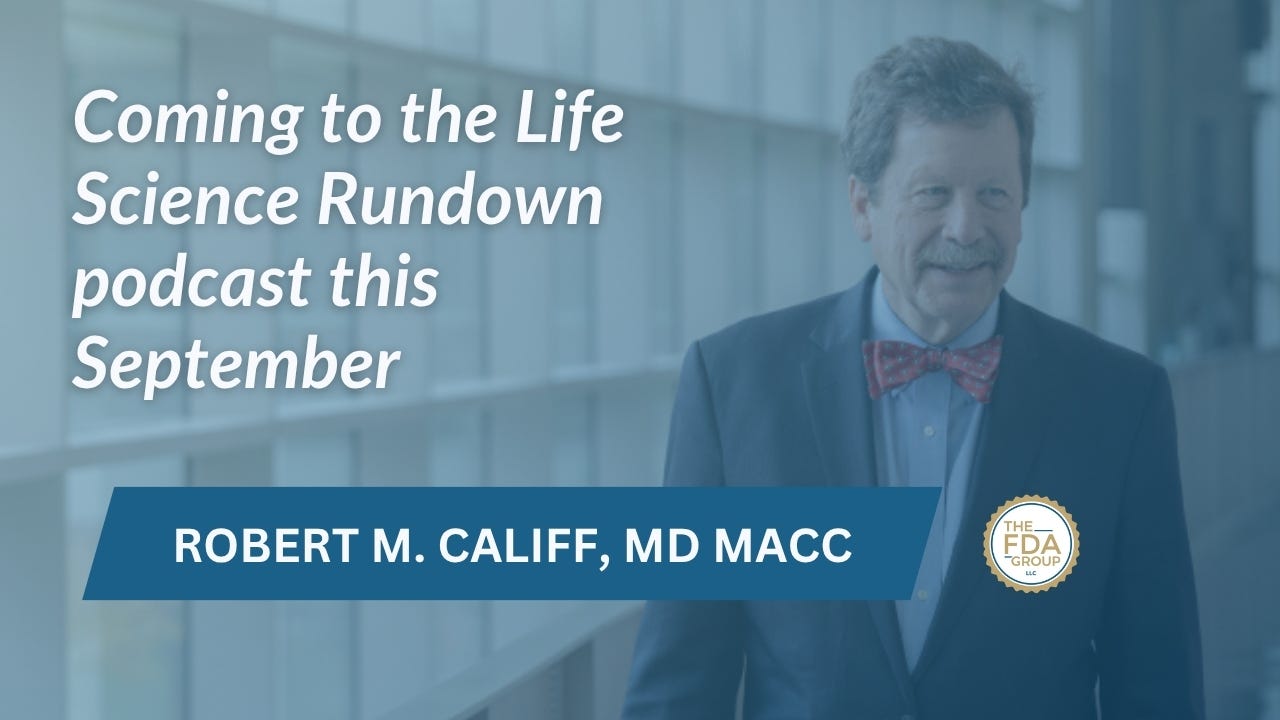
We're excited to announce a very special guest coming on the Life Science Rundown podcast in September: Robert M. Califf, MD, MACC!
Dr. Califf currently serves as an Instructor in the Department of Medicine and a Member of the Duke Clinical Research Institute at Duke University, and is an Adjunct Professor of Medicine in the Division of Cardiology. He previously served as FDA Commissioner and Deputy Commissioner for Medical Products and Tobacco. Before his FDA roles, Dr. Califf was a professor of medicine and vice chancellor for clinical and translational research at Duke, director of the Duke Translational Medicine Institute, and founding director of the Duke Clinical Research Institute.
He is also a Member of the National Academy of Medicine, has served on multiple FDA advisory panels and NIH advisory committees, and has led major initiatives to improve methods and infrastructure for clinical research, including the Clinical Trials Transformation Initiative (CTTI).
More details to come. If you aren't already, make sure you're subscribed wherever you listen to podcasts so you don't miss our conversation! We’ll of course post it here on the Insider Newsletter, too.
Alright, back to our regular newsroll items:
FDA Leadership and Administration
FDA lays out a reorganization plan that takes effect October 1: The agency published a Statement of Organization, Functions, and Delegations of Authority describing plans to centralize and enhance key functions, reduce redundancies, and improve alignment. The notice arrived largely unannounced and, unlike prior versions, does not state that the Secretary approved the structure or give an effective date. Reporting from NOTUS ties it to an internal effort called “Simple Reform,” first referenced in the fiscal 2027 budget request. Under the plan, individual centers would no longer run their own administrative functions such as HR, finance, and IT. The Office of Operations would absorb those under a shared service model. Specialized field inspectors who cover specific product categories would also shift to working as generalists across industries.
Commissioner search stays at three finalists: Bloomberg, Axios, and STAT have all reported that the search has narrowed to White House policy aide Heidi Overton, senior Pentagon health official Stephen Ferrara, and New York Cancer & Blood Specialists CEO Jeff Vacirca. The administration is separately vetting candidates for other senior roles and weighing whether to revive a coordinating leadership position eliminated in 2018 that would sit between the commissioner and the product center directors. The Atlantic published a profile of Overton describing her as a moderating influence between Make America Healthy Again goals and the mechanics of federal policymaking, and noted she is involved in drafting peptide policy.
Four pillars posted: On July 15, Diamantas published a blog post and a new webpage setting out four guiding principles that leadership is calling the pillars of the agency’s public health mandate. The pillars track the current agenda with a few new details.
Journal articles are not agency guidance: Diamantas gave written responses to Rep. Diana DeGette (D-Colo.) clarifying that articles published in medical journals by former Commissioner Martin Makary and former CBER Director Vinay Prasad, including their pieces on a plausible mechanism pathway and on CAR-T trial design, should not be read as agency guidance. The position is long-standing among government officials, though FDA regulators have used publications as a communications channel for years.
Digital health staffing shifts: 💉 Annie Saha moved into a new role as director of the Division of Digital Health Outreach in the Digital Health Center of Excellence. She appears to remain on an interim assignment at CDER as associate director for data science and artificial intelligence policy. The center has not yet named a replacement for its former chief medical officer for digital health.
CDRH recruiting reviewers for novel technologies: 💉 The device center is hiring two reviewers, one with experience in wearable sensors, artificial intelligence, and device interoperability, and one with experience in MRI safety and computational modeling. The postings follow user fee commitments to industry and public concern after last year’s reduction in force.
FDA General
CMC readiness strategy published: 💊 The FDA released its Strategy Document on Facilitating Chemistry, Manufacturing, and Controls Readiness for Products With Accelerated Clinical Development, a PDUFA VII commitment. It draws on lessons from the CMC Development and Readiness Pilot launched in 2022 and sets out the agency’s plans for fiscal 2026 and 2027.
Three cancer trial eligibility guidances finalized: 💊 The Oncology Center of Excellence issued final guidances on laboratory values, washout periods and concomitant medications, and performance status. All three update April 2024 drafts. Material changes were few, though the final versions revise references to diversity and note the concepts may apply beyond oncology. The agency tied the release to Operation TrialBlazer.
Seventeen peptide product-specific guidances revised: 💊 The FDA published revised draft PSGs covering 17 peptide products, including semaglutide, tirzepatide, liraglutide, teriparatide, and pegcetacoplan. The updates cover five areas: submission of recombinantly, synthetically, or semi-synthetically produced peptides as ANDAs, innate immune response testing, impurity thresholds, higher-order structure assessment, and biological activity assessment. The agency also withdrew its May 2021 guidance on ANDAs for certain highly purified synthetic peptide drug products, saying it no longer reflects current thinking, and plans to revise it this year. Comments on the Federal Register notice close on September 28.
Fiscal 2027 user fee rates issued: 💊💉 The agency published rates for prescription drugs, medical devices, generic drugs, and OTC monograph drugs, along with outsourcing facility fees. PDUFA base revenue for fiscal 2027 is $1,515,410,160 before adjustments. One detail worth noting for device firms: the agency states in the MDUFA notice that it met its fiscal 2025 hiring goals, so registration fees will not drop for fiscal 2027.
Nonclinical testing terminology rule reaches the White House: 💊 The Office of Information and Regulatory Affairs received a final rule titled “Nonclinical Testing Terminology” for administrative review, generally the last step before release. The rule is expected to build on the agency’s work to encourage alternatives to animal studies.
Expedited IND pilot gets more time and a webinar: 💊 The FDA extended the comment period on its proposed Expedited Investigational New Drug pilot to August 24 and held an educational webinar on August 6. As currently structured, the pilot would recruit external research institutions to provide advice and preliminary review of sponsors’ IND submissions, and would explore rolling IND submissions.
Three guidances land in one Friday Federal Register: 💊💉 The agency issued a new draft guidance on container closure systems and device constituent parts for biosimilar and interchangeable products, covering general and quality considerations and evaluation of the user interface for comparability to the originator. It also published a final guidance on assessing adhesion with transdermal and topical delivery systems for ANDAs, which follows three prior drafts dating to 2016, and a second revision of the draft guidance on assessing irritation and sensitization potential for those products.
Human factors guidance takes effect August 1: 💉 CDRH posted materials from its July town hall on the new final guidance covering human factors content in device submissions, including the recording, slides, and transcript. Updates to the foundational 2016 human factors guidance are still expected. The revised eSTAR and PreSTAR templates that account for the changes are already available, with the older versions retiring August 3.
Hemodialysis tubing guidance updated for the first time since 2008: 💉 The final guidance on 510(k) submissions for hemodialysis tubing modernizes the 2008 document without an intervening draft. Biocompatibility saw the most substantial revision: these products are now Category C for prolonged cumulative exposure, up from Category B. The agency also revamped shelf life and packaging expectations, removed a section on risks to health, and brought product code KOC explicitly into scope.
Pediatric Advisory Committee to review 27 products: 💊💉 The committee meets September 16 to discuss postmarketing pediatric-focused safety reviews for 17 drugs and biologics and 10 devices, including Tecentriq, Veklury, and Sprycel.
Blood supply roundtable scheduled: 💊 The FDA set its blood products roundtable for September 29, running 9 a.m. to 3 p.m. ET. Three sessions will cover current challenges to blood manufacturing supply chains, manufacturers’ views on root causes and solutions, and the role of federal agencies in building resilience.
Model-Integrated Evidence workshop set for August 27: 💊 The half-day event covers regulatory expectations and lessons learned for population PK modeling, locally acting PBPK modeling, and oral PBPK modeling in generic submissions. It will also include an update on the ICH M15 guideline on model-informed drug development.
Four new LEADER 3D case studies: 💊 The FDA added case studies to its rare disease drug development education program covering Benlysta (Bayesian methods), Ctexli (natural history data and a biomarker), Uplinza (a novel organ-tissue specific flare definition in the primary endpoint), and Skyclarys (a natural history study as confirmatory evidence). The repository now holds 12 case studies.
FDA researchers test accelerated approval disclosures: 💊 A paper in Therapeutic Innovation & Regulatory Science tested how well consumers, patients, and caregivers understood different accelerated approval disclosures on a website for a fictitious leukemia drug. Adding either a physician-labeling or consumer-friendly disclosure raised awareness, but only the consumer-friendly version improved comprehension of accelerated approval concepts.
CDER statistician on interim survival analyses: 💊 Speaking on a Friends of Cancer Research webinar, CDER statistical reviewer Shu Wang encouraged sponsors to communicate early with the agency on trial plans and to weigh drug class-specific safety concerns when planning interim looks. Draft guidance issued last year encourages sponsors to prespecify overall survival as a safety endpoint and to consider simulations when data are expected to be immature.
CDRH sees opportunity in the Rare Disease Innovation Hub: 💉 In the FDA’s Rare Connections newsletter, CDRH Director Michelle Tarver said the center’s addition to the hub creates more opportunities for engagement on rare disease devices and that cross-center collaboration can lower development barriers. The hub is now co-chaired by all three medical product centers.