



These RA/QA news rolls are available in full only to paid subscribers. Upgrade here. If you haven’t already taken our reader survey, it should only take 1 minute here.
This is our biweekly recap of news and industry happenings curated for our paid subscribers. Our goal is to bring you the headline news and the stories, research, and insights that might be harder to find.
If you haven’t upgraded to a paid subscription yet, you can do so here. Also, make sure to follow us on LinkedIn and catch the latest episodes of our podcast, The Life Science Rundown.
Here are some key items from the past couple of weeks.
💊 = Pharma, biologic, and biotech.
💉 = Medical device, medtech, diagnostics, and digital health.
Special Announcement!
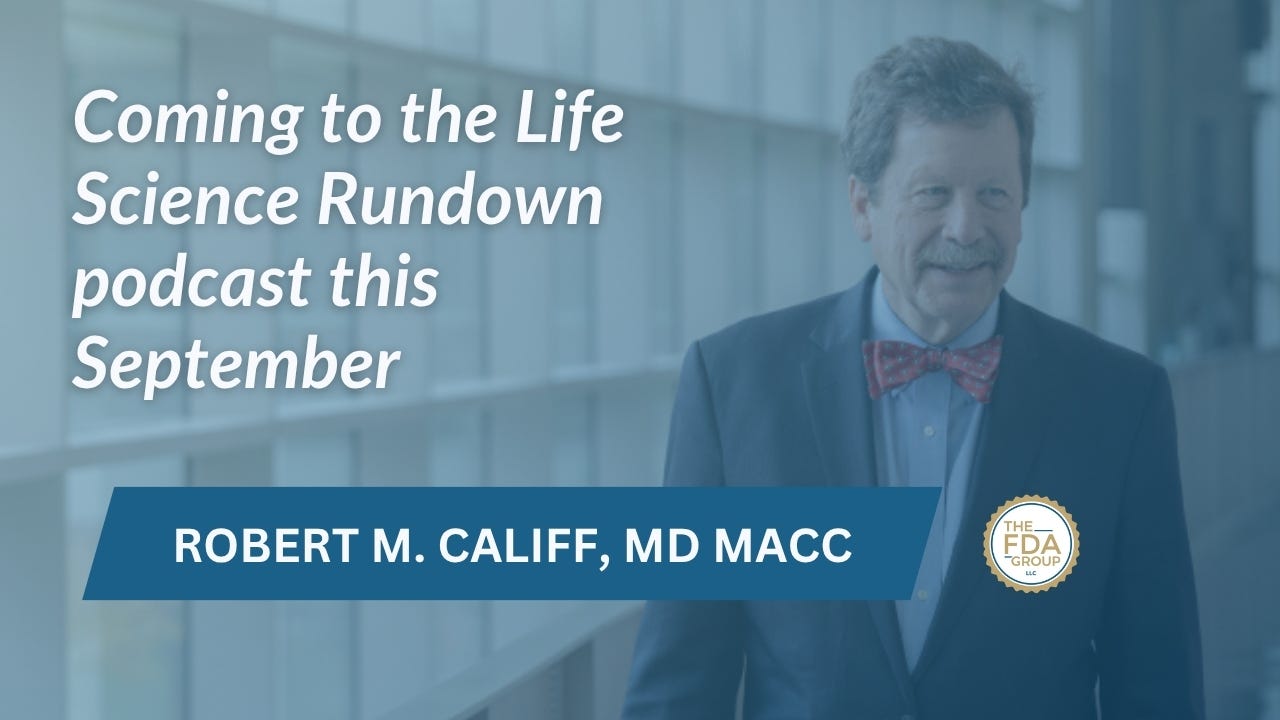
We're excited to announce a very special guest coming on the Life Science Rundown podcast in September: Robert M. Califf, MD, MACC!
Dr. Califf currently serves as an Instructor in the Department of Medicine and a Member of the Duke Clinical Research Institute at Duke University, and is an Adjunct Professor of Medicine in the Division of Cardiology. He previously served as FDA Commissioner and Deputy Commissioner for Medical Products and Tobacco. Before his FDA roles, Dr. Califf was a professor of medicine and vice chancellor for clinical and translational research at Duke, director of the Duke Translational Medicine Institute, and founding director of the Duke Clinical Research Institute.
He is also a Member of the National Academy of Medicine, has served on multiple FDA advisory panels and NIH advisory committees, and has led major initiatives to improve methods and infrastructure for clinical research, including the Clinical Trials Transformation Initiative (CTTI).
More details to come. If you aren't already, make sure you're subscribed wherever you listen to podcasts so you don't miss our conversation! We’ll of course post it here on the Insider Newsletter, too.
Alright, back to our regular newsroll items:
FDA Leadership and Administration
More detail emerges on the “Simple Reform” reorganization: The reorganization notice the FDA published in late July would restructure key parts of the agency, and HHS has confirmed it is intended for implementation on October 1, the start of federal fiscal 2027. Under the plan, the scope of the Office of Operations expands significantly, as does the Office of Public Affairs. The notice establishes a new Office of Mission Information and Technology Services, an Office of National Health Security, and an Office of Health Advancement.
Officials push back on the inspectorate reading: Associate Commissioner for Inspections and Investigations Elizabeth Miller and Acting Chief of Staff Lowell Zeta published an FDA Voices blog addressing concerns that the reorganization would undo the 2017 “Program Alignment” restructuring of inspections staff. The specific worry among stakeholders was that investigators would move into generalist roles rather than specializing by product type and subject matter.
Ibrahim named permanent CDER deputy director: Veteran regulator Sarah Ibrahim was named permanent deputy center director for regulatory programs at CDER after eight months in the role on an acting basis. She joined CDER in 2014 and worked in the Office of Generic Drugs. The agency has still not announced who will lead CDER permanently; Mike Davis has held the role on an acting basis since May.
Mullin retires from CDER: Theresa Mullin, who led CDER’s patient-focused drug development initiative and international work as associate director for strategic initiatives, has retired from the agency. Mullin joined CDER in 2007 after serving in the Office of the Commissioner as assistant commissioner for planning.
CBER leadership applications closed: The job postings for CBER Deputy Center Director and Office of Therapeutic Products super office director closed August 5. The White House and HHS are still expected to announce their plans for the agency’s top ranks as a suite of senior leadership hires.
FDA consolidates its social media presence: The agency is deactivating several legacy accounts on X and will post from @FDA, @FDADrugs, and @FDADevices instead of its various other handles. More specific accounts, including @FDASpox, @FDAOncology, @FDACBER, @FDAWomen, @FDACDERDirector, and @FDAMedia, will be deactivated September 12.
HHS publishes its semiannual regulatory agenda: HHS released the agenda listing regulatory activities the department expects to undertake in the foreseeable future, a component of the Unified Agenda published in July. It indicates the FDA is expected to issue proposed rules on direct-to-consumer advertising and nonclinical testing, a final rule on Patient Medication Information, and a long-term action on prescription drug marketing. The HHS agenda contains fewer entries than the Unified Agenda and introduces no new FDA topics.
FDA General
PDUFA VIII commitment letter published: The FDA released its draft commitment letter for the eighth iteration of the prescription drug user fee program, covering fiscal years 2028 through 2032. The letter covers review performance goals, a new pivotal protocol prioritization commitment, a CMC facility lifecycle program with new pre-submission and post-inspection meeting types, enhancements to formal meetings including multi-divisional meetings, and continued work on cell and gene therapy. It also proposes removing some PDUFA VII elements, including the STAR pilot and the CMC Development and Readiness Pilot. Comments close October 16, and a public meeting is set for September 16.
GDUFA IV commitment letter proposes onshoring incentives: The FDA released the draft commitment letter for the fourth reauthorization of the Generic Drug User Fee Amendments, which expires in September 2027. Proposals include updates to ANDA review timelines and communications, a new meeting structure, and a provision letting certain existing U.S. facilities request surveillance inspections ahead of an ANDA, prior approval supplement, or drug master file submission. The agency also recommends statutory changes raising the foreign facility fee differential from $15,000 to $25,000. A public meeting is set for September 17.
Formal meetings guidance finalized: 💊 The FDA finalized its recommendations on formal meetings between the agency and prescription drug product sponsors, replacing a 2023 draft. The 24-page document describes meeting types, formats, and requests, along with procedures and content for meeting packages. It applies to sponsors of drugs or biologics regulated by CDER or CBER, and preserves the structure and much of the content of the draft with modest changes.
New draft guidance on container closure systems for drugs and biologics: 💊 Two weeks after issuing guidance on container closure systems for biosimilars, the FDA released a broader draft guidance on CCS for drugs and biologics. When finalized, the document would supersede the agency’s CCS-as-packaging guidance from 1999 and 2002. The draft signals a larger revamp, stating that the FDA intends to supplement it with additional topic-specific guidances.
Biosimilar presentations draft guidance issued: 💊 The FDA issued a draft guidance on container closure systems and device constituent parts for biosimilar and interchangeable biological products, known as the presentation of the medicine. The recommendations expand on the 2021 biosimilar Q&A guidance, with emphasis on design differences between originator and biosimilar presentations, and focus primarily on assessing the user interface for combination products through a three-step comparative analysis.
Transdermal and topical generic guidances released: 💊 The FDA issued a final guidance on assessing adhesion with transdermal and topical delivery systems for ANDAs and a third draft of its guidance on assessing irritation and sensitization potential. The adhesion guidance follows three prior drafts, the most recent from 2023. The irritation and sensitization revision updates recommendations on when sensitization studies are not needed and when a combined study is appropriate. A workshop on bioequivalence for topical and transdermal generics is set for September.
Human factors guidance takes effect, and the 2016 guidance is updated: 💉 The FDA’s new final guidance on the content of human factors information in device submissions went into effect over the weekend of August 1, as the older eSTAR and PreSTAR templates were retired. The agency also issued the anticipated conforming updates to the 2016 human factors guidance, removing Appendix A, a sample outline of a human factors report, which is now covered in the new content guidance. The 2016 document lost about four pages.
First mRNA flu vaccine approved: 💊 The FDA approved Moderna’s seasonal influenza vaccine mFlusiva in adults 50 and older, six months after former CBER Director Vinay Prasad controversially refused to review the product. The agency granted full approval in adults 50 to 64 and accelerated approval in the 65-and-older cohort, reflecting Moderna’s amended application, with a required postmarketing study to confirm benefit in older adults. The Phase 3 trial enrolled 40,805 adults across 11 countries and showed 26.6% relative vaccine efficacy against a standard-dose comparator. The June advisory committee had voted unanimously in favor in both age groups.
Quantitative Medicine Innovation Network takes shape: 💊 The FDA published a request for information asking what the new Quantitative Medicine Innovation Network should do, tied to CDER’s Quantitative Medicine Center of Excellence. A September 1 meeting with the Duke-Margolis Institute will inform the effort, and the speaker list includes acting CDER Director Mike Davis, QMCoE Director Rajanikanth Madabushi, Office of Clinical Policy Director Issam Zineh, regulators from the Swedish Medical Products Agency and the European Medicines Agency, and FDA veteran Janet Woodcock.
Drug repurposing meeting held: 💊 The FDA presented an early look at its analysis of drug repurposing feedback at a hybrid public meeting hosted by the Reagan-Udall Foundation on August 5. The docket, which closed in July, addressed disease areas with significant unmet need where sufficient evidence may already exist to support a new use, cases with promising preliminary data, and general barriers and opportunities.