



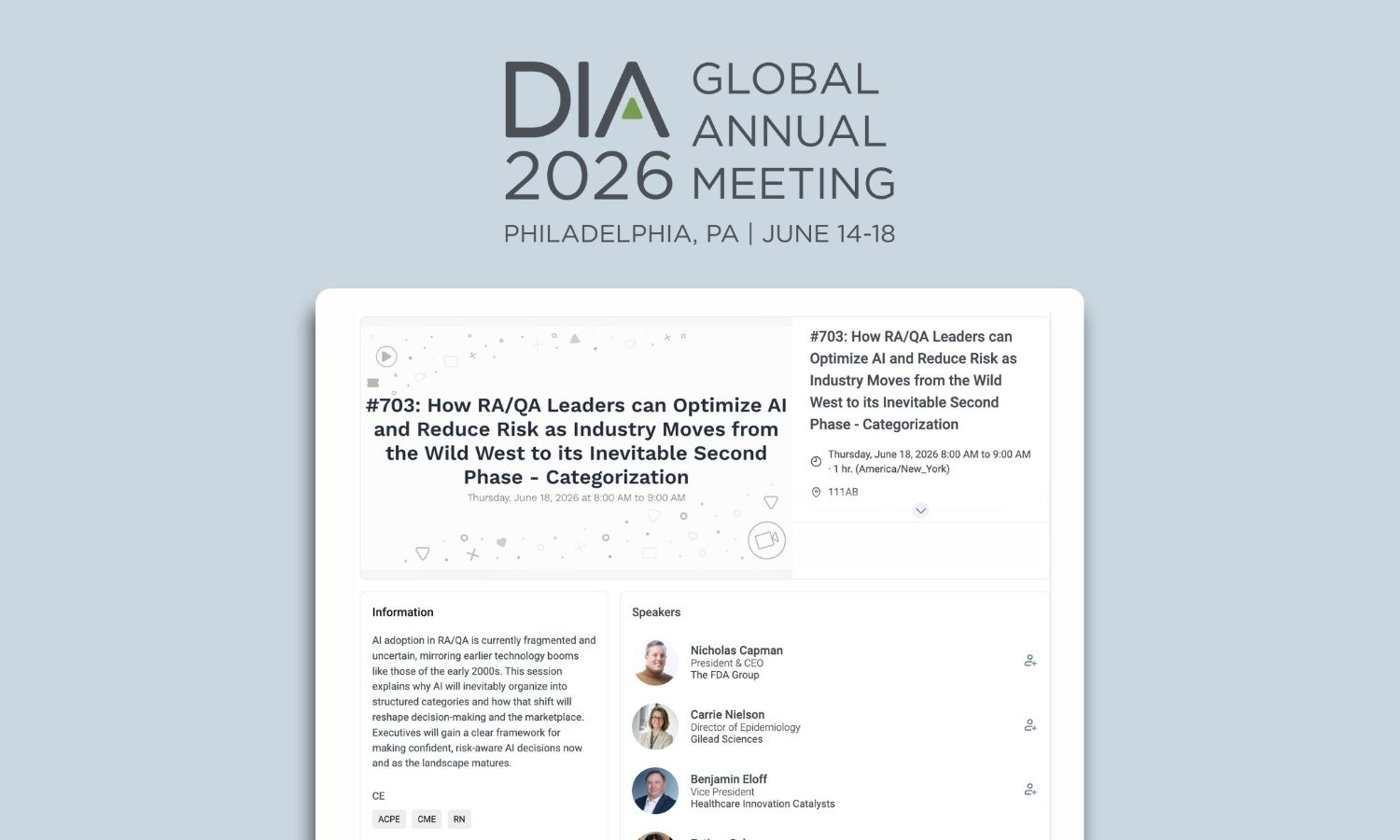
This is a guest post from Nick Capman, President and CEO of The FDA Group. See his full presentation at the DIA 2026 Global Annual Meeting, Thursday, June 18, at 8:00 AM in Philadelphia, alongside Carrie Nielson of Gilead Sciences, Benjamin Eloff of Healthcare Innovation Catalysts, and Fatima Sabar of Bluenote Health.
One of the more common questions I’m hearing from Quality and Regulatory leaders right now is which AI tool to buy. They want a name. Something they can put on a slide and take up the chain or into their steering committee. I’ve mostly stopped giving one, and the reason I’ve stopped is the whole point of the talk I’m giving at DIA in Philadelphia on the 18th.
(Register here if you want to see our panel live.)
Long story short, picking the winning tool today amounts to a guess, and not a very good one. Knowing when a whole category of AI has settled down enough to rely on is a different thing, and it’s what actually keeps you out of trouble with an investment like this.
That’s what I want to walk through here, ahead of the panel, for everyone who can’t be in the room.
We’ve seen this movie before
If you gave me a time machine and told me to find the answer to today’s AI question, I wouldn’t go to a lab or a keynote. I’d probably go to the exhibit hall of an industry conference event 25 years ago.
I’d step out of the time machine and find a few hundred software vendors, just like you’ll find now, each one describing what it does in its own private vocabulary, almost none of it connecting to anything else. Accounting in one system, inventory in another, manufacturing in a third, and good luck getting them to speak to each other.
Nobody back then could tell you which of those companies would still be around in five or ten years. Everybody was running pilots and essentially hoping. That was the Wild West of software, and (for those of us who are old enough) we lived through it.
Look at the AI products in our slice of the life sciences now and you’ll see the cycle repeating:
Tools that don’t integrate.
No shared language, so two vendors will describe the identical capability using words that don’t overlap at all.
Pilots everywhere.
Real doubt about which platforms make it through the decade.
It’s basically the same exhibit hall with a new generation of tools. The thing I’m stressing is that all the chaos of the last software cycle ultimately turned out fine. The mess wasn’t evidence that the technology was “bad.” It was just an early and natural period of point solutions.
Every time this cycle repeats, that initial messy flood of products resolves the same way: the market sorts itself into categories with names. AI is going to do that too. I can’t tell you the exact year of course, and anyone who claims they can is probably trying to sell you something.
But it’s something to expect and use to inform your decisions now.
Trust, and why there isn’t much of it yet
Adoption in this context runs on trust, and AI applications in our space don’t have a whole lot to spend yet. (Lots of hype, promise, and pressure, but not much trust.) I think about trust as character times competence, and the word “times” matters because if either one is close to zero, you’ve got nothing.
If you’ll indulge my framework for a moment:
Character is the stuff about who’s behind the system. Who built the model, what they trained it on, what the vendor is really being paid to do, whether you can see inside it well enough to even ask. For most enterprise AI today, those answers range from fuzzy to nonexistent.
Competence may not be quite as exciting, but it’s just as important: does it do the same thing twice? Can you validate it, reproduce it, and defend it when an investigator is sitting across the table? A slick demo tells you just about nothing here, the same way a slick ERP demo in 1998 told you nothing about whether the install would survive your actual operation. (Most of us learned that one the hard way.)
Again, AI is low on both right now, which is where a lot of this still sits. That means your risk around any decision-making is high.
Why building your own usually ends badly
There’s a version of the software story in a lot of companies where someone stands up and says the company should wave away the vendors and build its own tool instead. That way, they can “customize it” to exactly how they work and “own the whole thing.” I get the appeal, and the intention is good here. But I’d walk them past the graveyard first:
Hershey went live with a big ERP system in 1999 and botched order fulfillment right as Halloween orders were stacking up, and it cost them north of a hundred million dollars in sales they couldn’t ship.
The NHS in the UK spent the better part of a decade on a national IT program and pulled the plug in 2011 after something like ten billion pounds.
Knight Capital deployed bad trading software one morning in 2012 and lost around 440 million dollars before lunch.
FoxMeyer, a drug distributor with real scale, bet the company on a custom ERP build and ended up in bankruptcy.
None of these companies or organizations was broke or short on talent when they started. What sinks these projects is fairly consistent, and most of the famous flameouts hit at least three of the four:
The outside vendor gets better at the narrow problem than your team ever will, because the narrow problem is their entire business and a side project for you.
The technology moves faster than you can build, so the thing you’re constructing is dated before it ships.
The market eventually consolidates around a couple of platforms, the way it did around SAP and Salesforce, and now you’re the only shop on earth still maintaining your snowflake system.
The maintenance is forever: patches, integrations, security, the audit trail, the support desk, all of it landing on people you hired to do quality, not to run a software company.
That last point is the one I’d underline. You’re not a software company, and that’s fine! It’s just a good reason to think hard before you commit to building something while the ground under the whole category is still moving.
Categories are coming, and they change everything
Enterprise software didn’t stay a free-for-all forever. It grew up, and you can practically read the timeline off the acronyms:
ERP and MES and SCM in the early nineties.
CRM, eQMS, PLM by the middle of the decade.
CTMS, EDC, ePRO rolling into the 2000s.
eTMF and RIM after that.
Every one of those letters marks the moment a confusing pile of tools turned into something you could name and shop for.
Naming does more work than people give it credit for. Once a category has a name, everyone can finally talk about it the same way. You know who owns it inside your org, you can write governance for it, and you can line up three vendors and compare them on terms that actually match (instead of squinting at three pitches that don’t). After that point, buying gets safer and scaling gets easier, because everybody finally agrees on what the thing is.
AI is next in that line. I’m confident about the direction even if it’s impossible to predict the exact timing. When its categories firm up, you’ll get the same payoff the older acronyms delivered, and the buying decision that feels treacherous today will feel routine. We’re just not quite there yet.
What I’d actually use today
This is not an argument for sitting still. Some AI is already mature enough that ignoring it would be its own mistake.
Large language models (ChatGPT, Copilot, Gemini, Claude) and the assistants and wrapper apps built on top of them now have a track record. Quality and regulatory teams are already using them to draft documents and chew through routine compliance work faster. With sensible governance, guardrails, and human-in-the-loop operation, there are genuine use cases for them right now. (There are also obvious temptations to recklessly outsource sensitive, controlled work to them, as detailed in this FDA warning letter).
Then there’s the next layer up: AI built for specific jobs in our industry, such as drug discovery and design, audit and compliance automation, and safety and surveillance monitoring. These are worth getting your hands on, and you should! What I’d warn against is letting any of them become load-bearing this early. If ripping one back out would break the systems you run your operation on, you’ve leaned on it too hard, too soon, for a category nobody has finished defining. Experiment responsibly.
A few questions
If you ignore everything else and keep one thing, keep this.
What category is this, really? Name the kind of problem the AI solves, the way you’d separate an ERP from a CRM.
How mature is that category? Still fragmented and experimental, or settled and widely adopted?
What governance does the risk call for? Match your oversight and validation to the actual business and regulatory exposure. Higher risk, more rigor. Lower risk, less.
Now decide. Adopt it safely, watch it and wait, or leave it for now.
The reason this holds up is that it forces the maturity question before the buying question, which is the order most people get backward.
The takeaway
“AI” isn’t a decision you make once and file away. You’ll keep making these calls for years, in a market that’s still taking shape under you. The firms that come out ahead will be the ones that moved at the right time, with the right level of conviction. I’d quit trying to guess which tool wins and learn to read when a category is ready instead.
I’ll be making this case in full on a panel at the DIA 2026 Global Annual Meeting, Thursday, June 18, 8:00 AM in Philadelphia, alongside Carrie Nielson of Gilead Sciences, Benjamin Eloff of Healthcare Innovation Catalysts, and Fatima Sabar of Bluenote Health. If you’re there, come find me! Connect with me on LinkedIn and send me a message if you’d like to meet up. If you’re not able to be there, we’ll bring the takeaways back here afterward.
Who is The FDA Group?
The FDA Group helps life science organizations rapidly access the industry's best consultants, contractors, and candidates. Our resources assist in every stage of the product lifecycle, from clinical development to commercialization, with a focus on Quality Assurance, Regulatory Affairs, and Clinical Operations.
With thousands of resources worldwide, hundreds of whom are former FDA, we meet your precise resourcing needs through a fast, convenient talent selection process supported by a Total Quality Guarantee. Learn more and schedule a call with us to see if we’re a fit to help you access specialized professionals and execute your projects on time and on budget.