



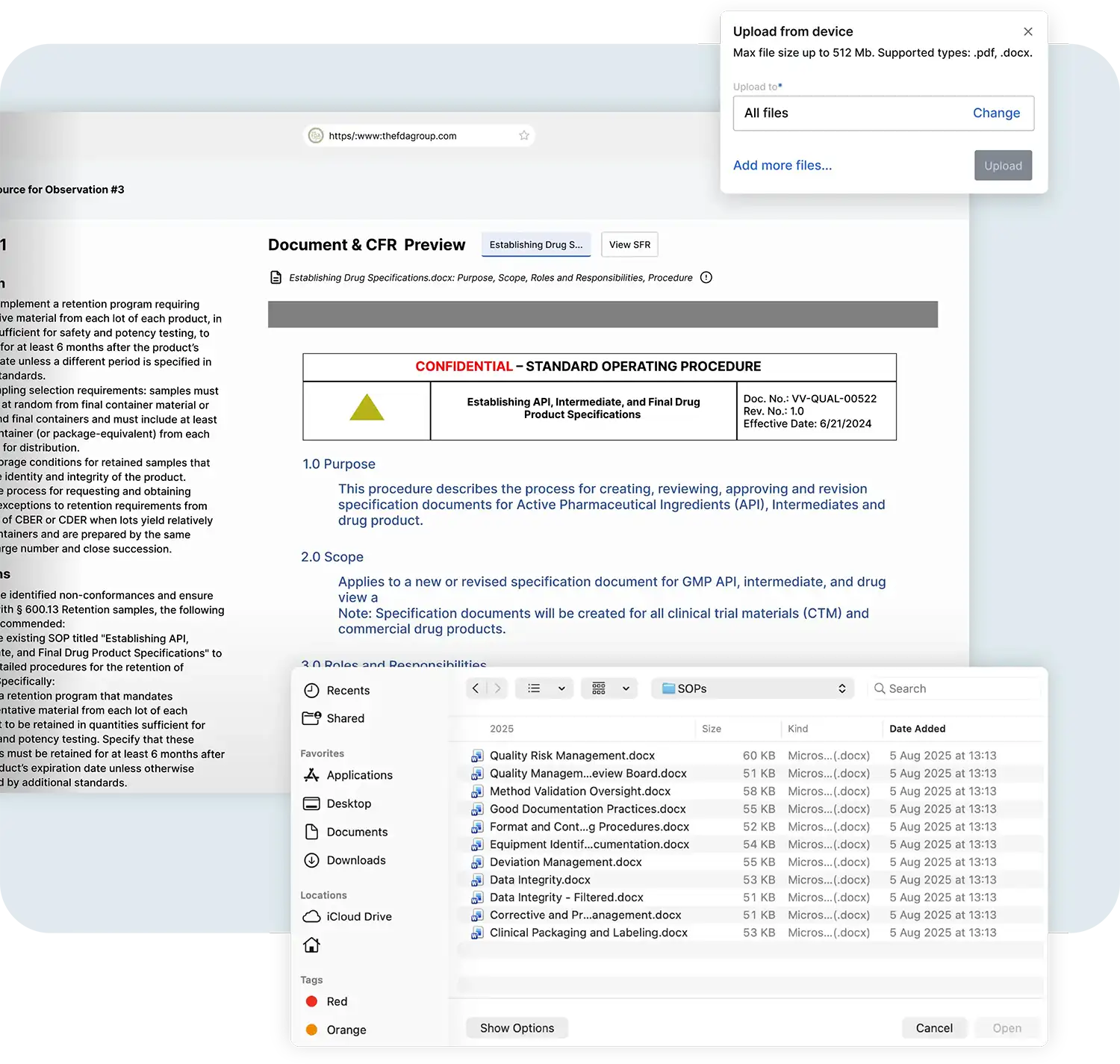
AICA, the Audit Intelligence Compliance Assistance, is a patent-pending AI-powered compliance auditing tool we launched this year that analyzes all of your QMS documentation at machine speed.
It eliminates the sampling and blind spots common with fully manual document reviews. Upload your documents and get results the same day. If you’re new to AICA, learn more about it at aica.thefdagroup.com. Get a personalized demo here, or watch our intro below.
Earlier this year, we published a short AICA series on what the platform does, answers to the questions we’re often asked about it, and how quality teams can put it to work across internal audits, supplier audits, and inspection readiness.
Today, we wanted to go deeper to explain the mechanics of the core question AICA is built to answer, and how it fits alongside the parts of compliance work that belong to a human reviewer.
One way to do that is to look through the lens of common compliance issues and how they can be mitigated using a tool like this. If you spend any time in the FDA’s inspection dashboard, you might notice the same pattern repeating year after year. Many of the top citations under 21 CFR Part 211 have to do with procedures of some kind:
Procedures not in writing.
Procedures that are written but incomplete.
Procedures that exist but aren’t being followed.
In the FDA’s fiscal year 2025, the single most-cited observation, §211.22(d), procedures not in writing and fully followed, accounted for 181 warning letter citations on its own. (And certainly many more 483 observations.)
It’s tempting to draw a straight line from that data to a tool like AICA:
Procedures are the problem. AICA audits procedures. Therefore, AICA solves the problem.
We built AICA to support the RA and QA teams responsible for those procedures, and we want to be careful to define the use case precisely. So we sat down with Neal Siegel, a senior consultant who has worked extensively on AICA’s development and who presented on the FDA inspection dashboard at the PDA conference last year, to walk through a few questions more carefully:
What does AICA do when it reviews a procedure?
What does it see?
Where does its work hand off to a person?
And how should a quality manager reading a report understand what’s in front of them?
The conversation clarified something we’d been circling for a while. AICA does one well-defined part of compliance work, and it does it thoroughly. Understanding that part, its shape and where it connects to the rest, is the difference between using the tool well and misreading what it’s telling you.
The question AICA is built to answer
Neal’s framing is worth quoting directly:
“AICA looks at a regulation and says, ‘here are the things you should be doing.’ Then it takes your procedure and answers a single question: are the steps to meet those requirements actually written down? That’s the work. It’s not a checklist. It’s a contextual comparison between what the regulation requires and what your document says.”
That’s the work AICA does when you run procedures through it. There’s a regulatory requirement on one side, procedural language on the other, and an intelligent reading of whether the second meets the first.
Neal is careful to distinguish this from simple keyword matching or a surface-level scan. AICA goes further: it reads the regulation’s intent, reads your procedure’s language, and judges alignment between the two through an expert-informed interpretation. Where the procedure falls short, whether a required element is missing entirely or addressed too thinly to satisfy the requirement, AICA flags it.
He gave an example from a past audit that shows exactly the kind of gap AICA is designed to catch.
At a site he was dispatched to as a consultant, Neal asked the Quality team about its record retention period. Everyone in the room knew the answer: five years. Managers, QA staff, and even the CEO when he poked his head in. “See, Neal, it’s five years.” Neal’s response: “But it’s not written down anywhere!”
“It turns out they had a revision and it got dropped. It wasn’t a major problem, because everyone knew the practice. But if it was something more material that got lost in revision, and the FDA came in and said, ‘we’re looking at records retention and the regulation requires this and it’s not in your procedure,’ now you’re sitting with them and proving how long you actually retained records. That’s where it becomes a real problem.”
This is exactly the kind of gap AICA is built to find. The regulation requires a record retention period. Your procedure omits it, perhaps because it was lost in a revision, perhaps because it was always assumed. AICA reads both and surfaces the mismatch before an investigator does.
What AICA reserves for the human reviewer
Neal was as precise about AICA’s edges as he was about its strengths. Three of those edges are worth understanding before you read a report, because each one marks a point where AICA does its part and a person picks up theirs.
Let’s go through them one by one:
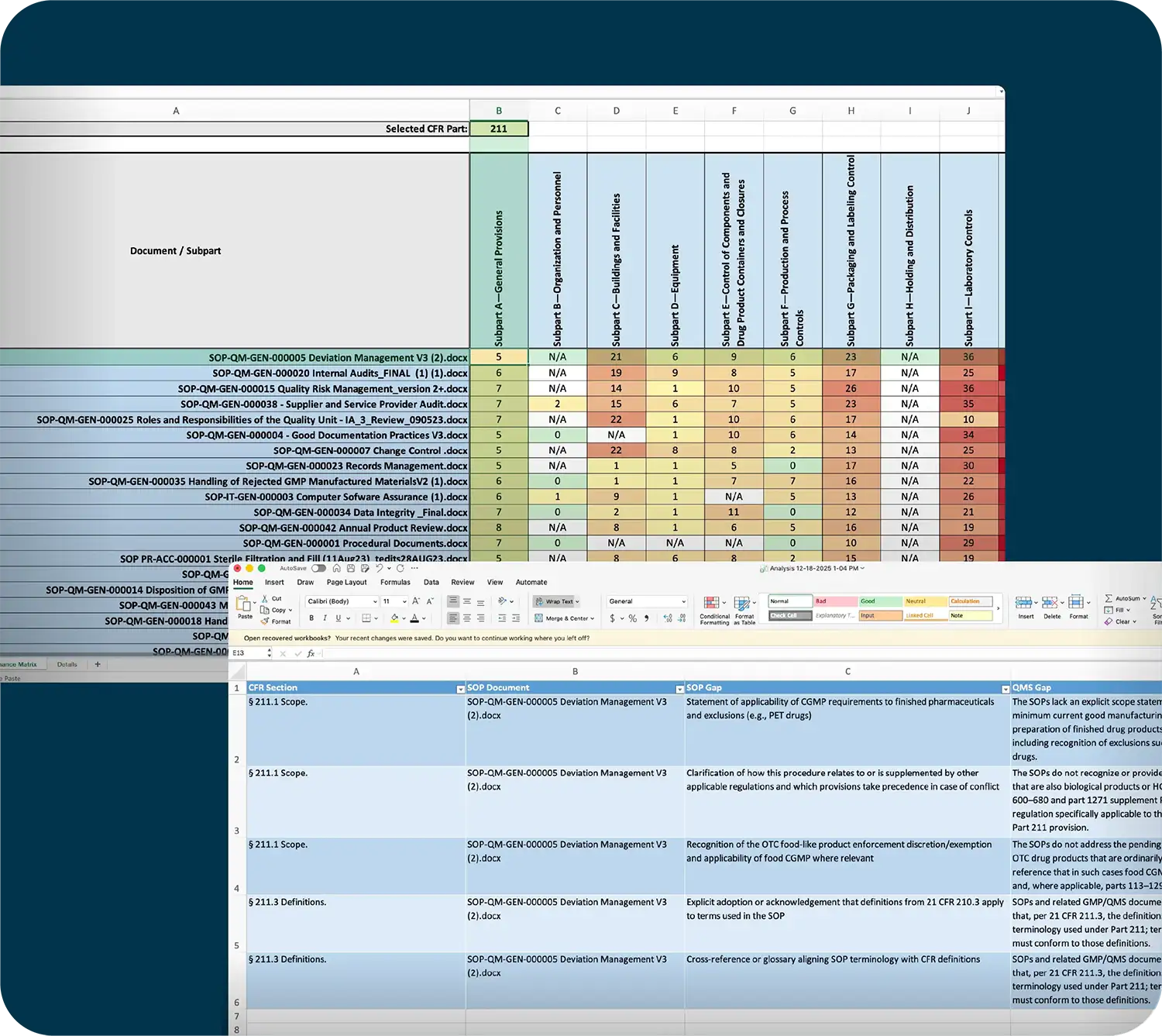
AICA works from the documents you give it. If your training procedure isn’t part of the upload, AICA will note that it doesn’t see one. That report is accurate to what AICA was handed, though it may not reflect the full state of your quality system, since the procedure could live elsewhere and simply not have been provided. AICA is built with this in mind. Rather than calling a document it can’t find an outright nonconformance, the report asks the reviewer to confirm whether the procedure exists elsewhere in the system. The wording is deliberate: It points the reviewer toward a quick confirmation instead of raising a false alarm.
AICA works at the documentation layer. It reads your SOPs, work instructions, forms, and policies, and measures them against a regulation you specify. Records like batch records, deviation reports, CAPA files, and training logs are the next layer, and that’s where a human reviewer takes over to answer the question an FDA investigator asks on-site: are you actually doing what your procedures say you’ll do? AICA gets the reviewer to that question faster by clearing the documentation layer first.
Physical operations stay with the people in the facility. A citation under §211.63, equipment design and location, comes largely from what an investigator sees walking through a site. AICA reviews the documentation for that equipment, including its qualification records, to ensure alignment with the regulation, and leaves the physical assessment where it belongs: with a human.
These edges matter because most real FDA citations have several dimensions.
Take §211.192, investigation of discrepancies and failures, the third-most-cited observation in the FY2025 data. A company might receive this citation because its investigation procedure is incomplete, because actual investigations weren't conducted, because investigations were conducted but poorly documented, or because the organization has developed a pattern of classifying nonconformances as "quality issues" to avoid the regulatory weight of the term.
AICA speaks directly to the first of those: whether the investigation procedure itself meets the regulation. The rest turn on records and practice, which is where a human reviewer carries the work forward.
This is the honest answer to the "Does AICA help with top citations?" question. It addresses one part of a multi-part problem, and it's the part that comes first, since strong procedures are the precondition for everything that follows.
Why human review is built in by design
Everything we just talked about is the reason AICA is designed around human review as a structural feature rather than an optional one.
A qualified Quality professional sits with AICA’s findings and applies the judgment that AICA, or any similar tool right now, is not positioned to apply. That might mean:
Confirming that a “missing” procedure exists elsewhere and simply wasn’t ingested by the tool.
Knowing that a finding doesn’t apply because the company contracts out the relevant process.
Recognizing that a procedural gap AICA flagged has been covered in practice through training and institutional knowledge, a real gap to close, but not a surprise to the team.
Neal put it this way:
“An experienced human auditor has context that a tool doesn’t. They’ve read four different procedures, they expected to find something specific, they didn’t find it, and they can make a nonconformance observation with confidence. AICA’s job is to get you to the point where you can make those calls faster and with better information.”
Where the value is compounding for AICA users
Having laid out where AICA's work connects to a person's, Neal was emphatic about where it pays off. The core value, in his framing, is time. And in complex organizations, the time savings multiply. We’re already seeing this with the teams using AICA.
"Think of a large, multi-site pharmaceutical manufacturer. It might have fifteen departments, each with ten procedures, some overlapping, some not. Traditionally, a team of two or three auditors goes in for a week. You're pulling the Quality Manager off their work for five days, pulling SMEs off their work, pulling auditors off their work. If AICA can cut that to three days and surface the procedures that have the most problems, you've just given back two full weeks of senior attention. That compounds across every audit cycle and every site.
For smaller organizations with, say, fifteen SOPs written by an outside consultant, the math is different, and Neal was candid that AICA's output can be a lot to take in for companies that aren't going to rewrite their procedures anyway.
But for distributed operations with pilot plants, offshore sites, and multiple functions, every run of AICA returns hours of specialized attention that would otherwise go to procedural review rather than the audit work only a person can do, like interviewing staff, reviewing records, and assessing implementation.
There's a second layer Neal kept returning to: Quality teams who use AICA regularly build a record of continuous improvement that an FDA investigator genuinely wants to see.
"When the head of Quality gets this report, they're not reading it as fires burning. They know they don't have fires. They've had plenty of inspections. What they're reading it as is opportunities for improvement. And that's the improvement piece they're going to have to show FDA next time: that they have a real, functioning continuous improvement program in place. The investment in AICA itself becomes part of that. You run it, you get recommendations, you prioritize, you act, you run it again. That's what a culture of quality looks like in practice."
The FDA doesn't just want compliant procedures. It wants evidence that companies are actively working to improve them. Used consistently, AICA produces that evidence as a byproduct of ordinary use.
Final thoughts and next steps
We built AICA to answer one question very well:
Does your procedural documentation align with the regulations it's meant to satisfy?
It reads with context, surfaces gaps intelligently, and gives a qualified reviewer a faster, cleaner path to the decisions only a person can make. Whether procedures are followed, what the records show, and what the floor looks like all stay with the reviewer/auditor, and AICA gets them there sooner by clearing the documentation layer first.
Neal closed with a note worth ending on. He’s been in this industry a long time, and he’s careful about how any tool gets presented.
“I want AICA’s presentation to the industry to be right, because so many software vendors oversell. What I can tell you is that when I walk into a one-day lab audit next week and I’m going to be working all night reviewing procedures, I would love to have had AICA run through the document set first. Walking in and saying, ‘here are the six procedures I want to look at out of everything you gave me,’ that changes what I can do in a day.”
That’s the honest case for AICA. It does one part of the work thoroughly, reliably, and at scale, so experienced people can spend their time where their judgment matters most.
This piece reflects a conversation with Neal Siegel, senior consultant and ongoing contributor to AICA’s development. Neal has decades of experience auditing pharmaceutical and medical device QMSs. Quotes are drawn from a working conversation and have been lightly edited for readability.
Watch our recent conversation with Neal about what 30+ years of FDA, consent decree, and GMP work has taught him about Quality:
Have questions or want to get a demo?
Want to see whether AICA fits your team? Visit aica.thefdagroup.com to learn more and get in touch. We’re onboarding teams to the tool right now.
